Many buyers choose ball valves based only on price. Later, they face leakage, torque problems, or certification risks. That mistake costs far more than the valve itself.
A ball valve is a quarter-turn valve that uses a rotating ball with a bore to control flow.
It provides fast shutoff, strong sealing, and wide pressure capability, making it ideal for oil & gas, chemical, water, HVAC, and sanitary industries.
In this guide, I will break down ball valve types, structures, materials, and selection logic. I will also share how I evaluate valves as a manufacturer with 15+ years of experience.
What Is a Ball Valve?
Many buyers know the name. Few understand how internal design affects safety and lifespan.
A ball valve controls flow by rotating a drilled ball 90 degrees inside the valve body.
When the bore aligns with the pipeline, flow passes. When perpendicular, flow stops completely.
Definition & Principle of Operation
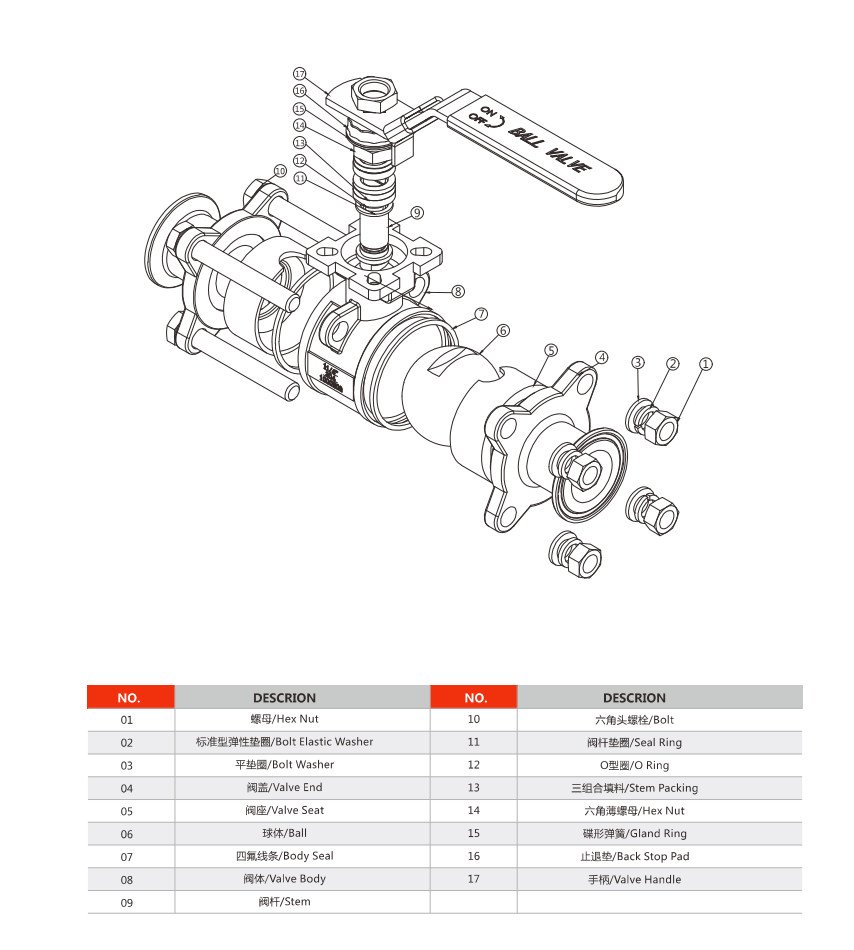
A ball valve contains five main parts:
- Body
- Ball
- Stem
- Seats
- Seals
The stem connects the handle or actuator to the ball. When the stem turns, the ball rotates.
Because the ball surface contacts the seat tightly, sealing is very reliable. In many of our stainless steel instrumentation ball valves, the floating ball design compensates for seat wear automatically.
Typical Industries & Why They Matter
I supply ball valves to:
- Oil & gas
- Petrochemical plants
- Power generation
- HVAC systems
- Water treatment
- Food & pharmaceutical
Each industry has different risk tolerance.
Oil & gas buyers care about pressure rating and fire safety.
Food buyers care about surface finish and cleanability.
Chemical plants care about corrosion resistance.
You cannot treat them the same.
Key Advantages vs Disadvantages
| Advantage | Explanation |
|---|---|
| Fast operation | 90° turn only |
| Bubble-tight sealing | Especially with PTFE seats |
| Wide pressure range | From vacuum to 10,000+ psig |
| Low torque | Easy automation |
| Disadvantage | Explanation |
|---|---|
| Poor throttling (standard type) | Seat damage risk |
| Possible cavity pressure buildup | Needs relief design |
| Seat wear in high-temp service | Material selection critical |
Ball Valve Classification (with visuals)
Ball valves look simple outside. Inside, structure differences change everything.
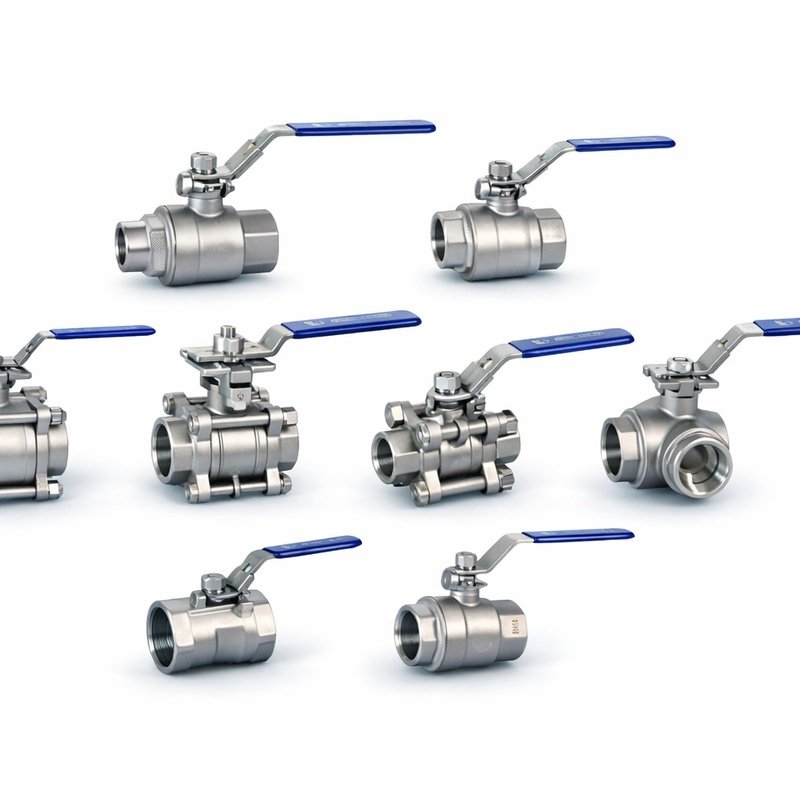
Ball valves are classified by actuation, port design, body structure, and materials.
Each classification directly affects pressure capacity, automation, and application safety.
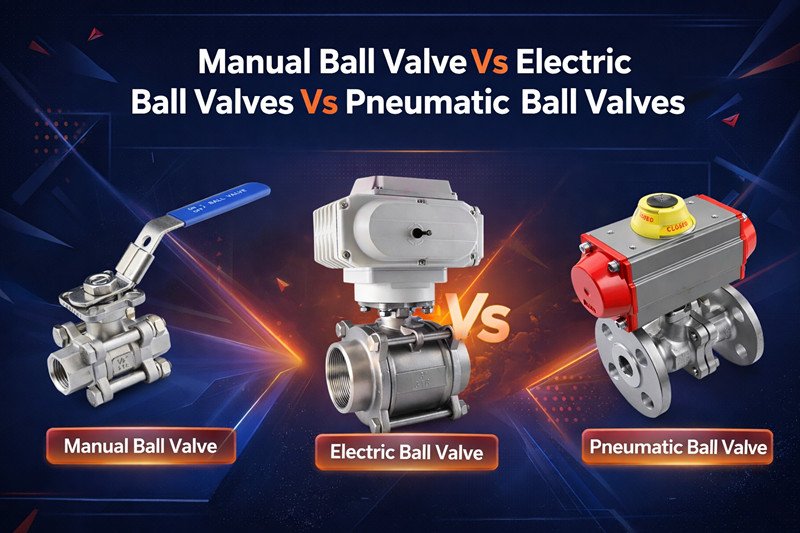
By Actuation
Manual

Manual valves use a lever or gear.
They are simple and reliable.
I recommend manual valves for:
- Instrument isolation
- Maintenance points
- Low automation environments
Electric Actuated
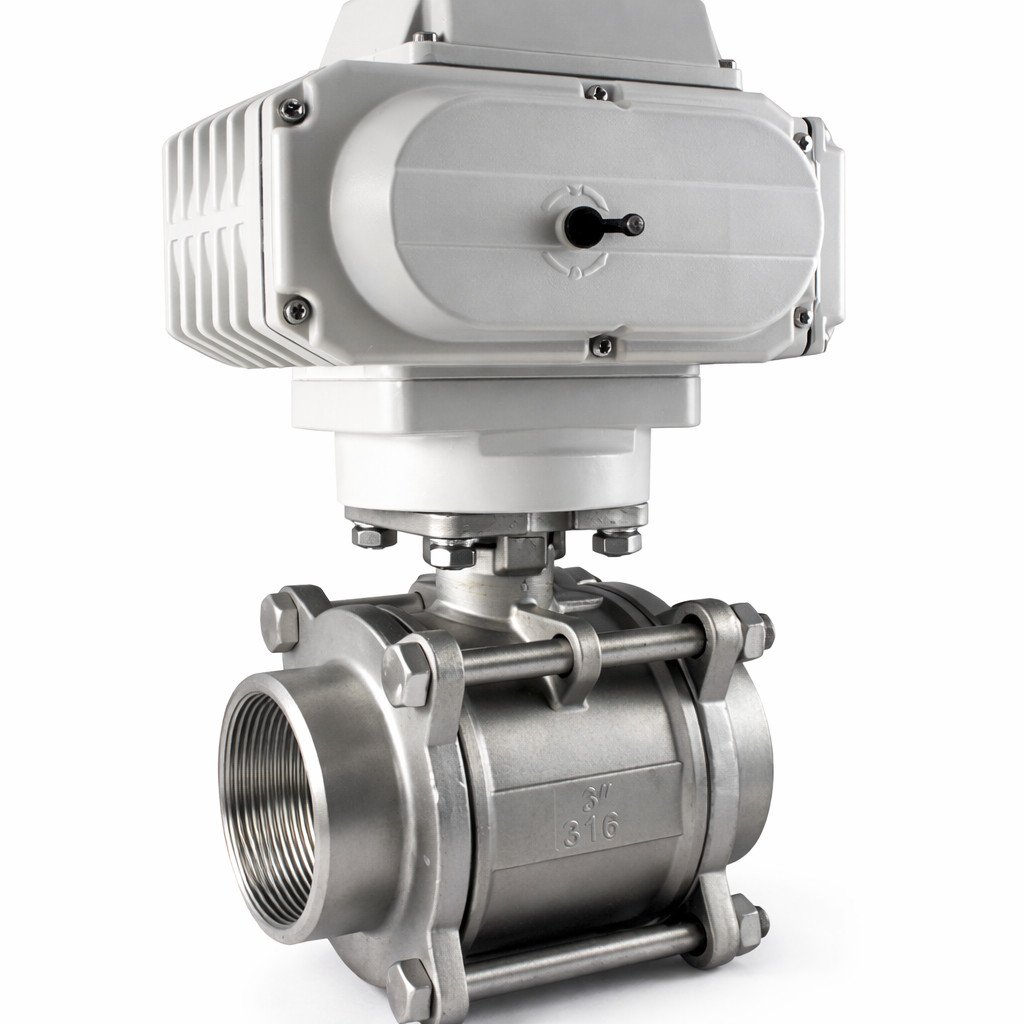
Electric actuators convert electrical signals into rotation.
They are common in water treatment and HVAC.
Pros:
- Precise control
- Easy integration with PLC
Cons:
- Slower response than pneumatic
Pneumatic Actuated

Compressed air drives operation.
Oil & gas plants prefer pneumatic systems.
Pros:
- Fast action
- Safe in hazardous areas
By Port & Flow
Full Port vs Reduced Bore
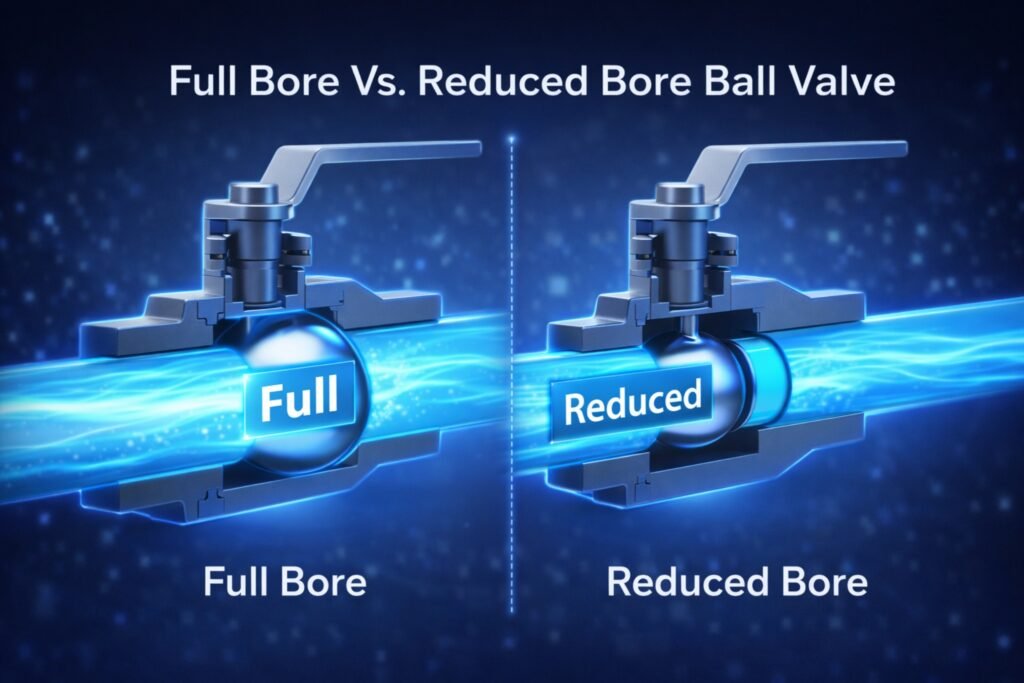
Full port means the ball bore equals pipe diameter.
Reduced bore means smaller internal opening.
| Type | Pressure Drop | Cost | Typical Use |
|---|---|---|---|
| Full Port | Very low | Higher | Pigging pipelines |
| Reduced Bore | Moderate | Lower | General isolation |
Full port valves maintain flow efficiency. Reduced bore saves cost.
V-Ported Valves for Control
A V-shaped opening allows controlled throttling.
I only recommend V-port valves when real control is required.
Standard ball valves should not be used for frequent throttling.
Multi-Port Valves (L-Port, T-Port)

Multi-port valves redirect flow.
- L-port: Select between two outlets
- T-port: Divert or mix
These are common in process switching systems.
By Mounting & Mechanism
Floating vs Trunnion Mounted
Floating ball design allows ball movement to press against seat.
Most instrumentation valves use floating design.
Trunnion-mounted design supports the ball with top and bottom trunnions.
| Type | Pressure | Size Range | Torque |
|---|---|---|---|
| Floating | Medium | Small–Medium | Higher |
| Trunnion | High | Large | Lower |
For 6,000–10,000 psig service, trunnion designs are common :contentReference[oaicite:2]{index=2}.
One-Piece, Two-Piece, Three-Piece Designs
- One-piece: Compact, low cost
- Two-piece: Most common industrial type
- Three-piece: Easy maintenance
I often suggest three-piece valves for plants that require periodic cleaning.
Material & Seat Types
Soft-Seal vs Metal-Seat
Soft seats:
- PTFE
- PEEK
- Nylon
Our PTFE seats operate up to 400°F in many designs.
Metal seats:
- For high temperature
- For abrasive media
Body Materials
Common:
- SS304
- SS316 / 316L
Industrial:
- Carbon steel
- Duplex
- Super duplex
Exotic:
- Monel
- Hastelloy
- Alloy 625
Material selection must consider:
- Chloride level
- Temperature
- Pressure
- Cost target
Where Ball Valves Are Used
Applications define failure risk. Wrong valve choice leads to shutdown.
Ball valves are widely used in oil & gas, petrochemical, cryogenic, HVAC, and sanitary industries because they offer fast isolation, compact design, and strong sealing performance under diverse pressure and temperature conditions.

Oil & Gas Pipelines
Key requirements:
- Fire-safe design (API 607)
- High pressure
- Anti-static design
DBB valves reduce leak paths significantly.
Petrochemical Plants
Corrosive media demand 316L or duplex.
Seat compatibility must be verified.
Cryogenic Service
Low temperature causes seat shrinkage.
Special stem seals and cavity relief are required.
HVAC & Water Distribution
Cost sensitivity is high.
Brass or carbon steel may be acceptable.
Food & Pharma
Sanitary ball valves must meet:
- 3A
- BPE
- DIN
- ISO
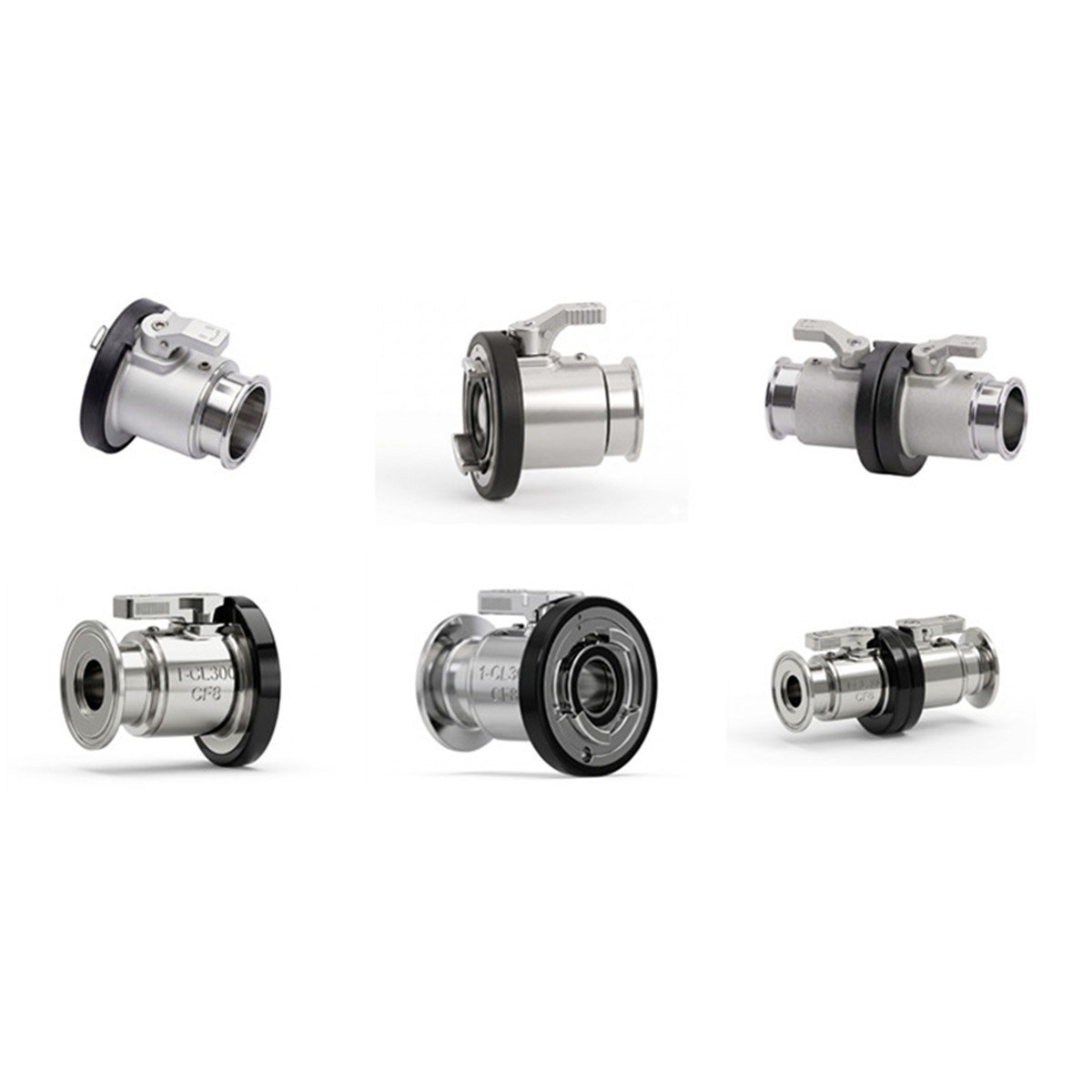
Sanitary series catalogs show multiple standard options.
Surface finish and dead-leg control are critical.
Ball Valve Selection Guide
Many buyers send me only size and pressure. That is not enough.
Correct ball valve selection requires evaluating media type, pressure, temperature, corrosion level, and required standards before confirming body material, seat type, and design structure.
Key Criteria: Media, Pressure, Temperature
Ask these questions:
- What is the fluid?
- Maximum pressure?
- Maximum temperature?
- Frequency of operation?
For example:
- PTFE seats: -54°C to 204°C
- PEEK seats: Higher pressure tolerance
Selection for Corrosive Environments
Chloride above 200 ppm?
Avoid 304.
Strong acid?
Consider Hastelloy.
Standards & Certifications
Important standards:
- API 607 (fire safe)
- ANSI / ASME B16.34
- ISO standards for sanitary fittings
Certification authenticity matters. Always verify mill test reports.
Performance & Maintenance
Most failures are predictable.
Ball valve failures usually result from seat wear, improper material selection, cavity pressure buildup, or poor installation. Regular inspection and torque checks significantly extend service life.
Common Failure Modes
- Seat erosion
- Stem leakage
- Packing degradation
- Body corrosion
Troubleshooting
Leak at stem:
- Tighten packing nut
- Replace packing if needed
High torque:
- Seat swelling
- Media buildup
Routine Maintenance Checklist
- Visual inspection
- Operate valve periodically
- Check packing torque
- Verify actuator calibration
- Confirm pressure rating
Comparison: Ball Valves vs Other Valves
Choosing wrong valve type creates cost risk.
Ball valves offer faster operation and better sealing than gate or globe valves, while butterfly valves provide lighter weight but lower sealing reliability at high pressure.
| Feature | Ball | Gate | Globe | Butterfly |
|---|---|---|---|---|
| Operation Speed | Fast | Slow | Slow | Fast |
| Sealing | Excellent | Good | Good | Moderate |
| Throttling | Limited | Poor | Excellent | Moderate |
| Cost | Medium | Medium | Higher | Lower |
| High Pressure | Yes | Yes | Yes | Limited |
FAQs & Decision Tools
Buyers want fast answers.
The fastest way to choose a ball valve is to define media, pressure, temperature, and required standards first, then match body material and seat type accordingly.
Quick Selection Flowchart
- Define media
- Check corrosion risk
- Confirm pressure
- Confirm temperature
- Select seat
- Confirm standards
- Decide actuation
Frequently Asked Questions
Q: Can ball valves throttle flow?
A: Only V-port types are recommended.
Q: How long does a ball valve last?
A: Depends on media and cycling frequency.
Q: Is 316L always better than 304?
A: Not always. It depends on chloride exposure.
Conclusion & Recommendations
Ball valve selection is engineering, not guessing. Define conditions first, then choose structure and material carefully.
Beyond Fluid is a leading supplier of stainless steel ball valves for over 15 years. Contact us for more details.