High rack density creates heat fast, and air alone often falls behind. That gap causes thermal risk, wasted power, and scaling limits for modern AI infrastructure.
A coolant distribution unit is the control point that moves, isolates, monitors, and stabilizes liquid cooling between facility water and IT equipment. I see it as the practical bridge that makes high-density liquid cooling safe, scalable, and serviceable.
Once I explain the CDU clearly, the buying decision becomes much easier. The real question is not whether liquid cooling is interesting. The real question is whether your facility can support growing heat loads without losing control.
What Is a Coolant Distribution Unit (CDU)?
Dense compute loads create more heat than many rooms can remove with air alone. When buyers treat the CDU as only a pump box, they miss why it matters.
A CDU is the liquid cooling hub that transfers heat, manages flow, protects the IT loop, and keeps temperatures stable. I see it as the operating center of a modern liquid cooling system.
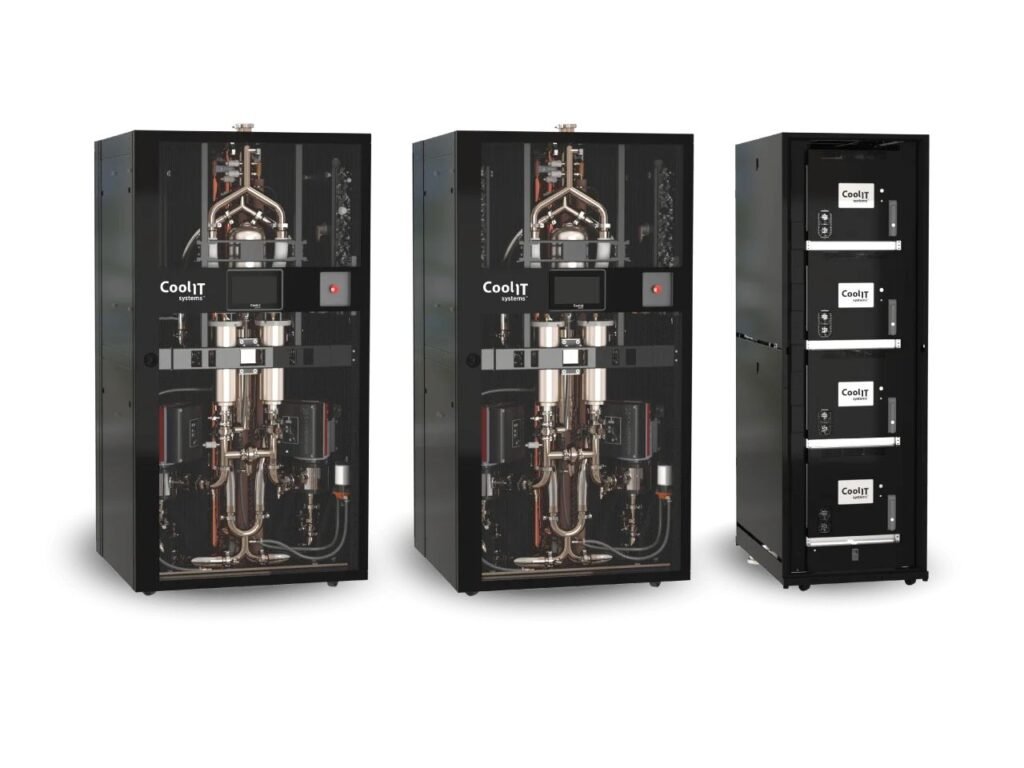
The CDU’s role in a liquid cooling system
When I explain a CDU to customers, I start with one simple idea: it separates the building side from the IT side. That separation is the reason the whole liquid cooling system becomes manageable.
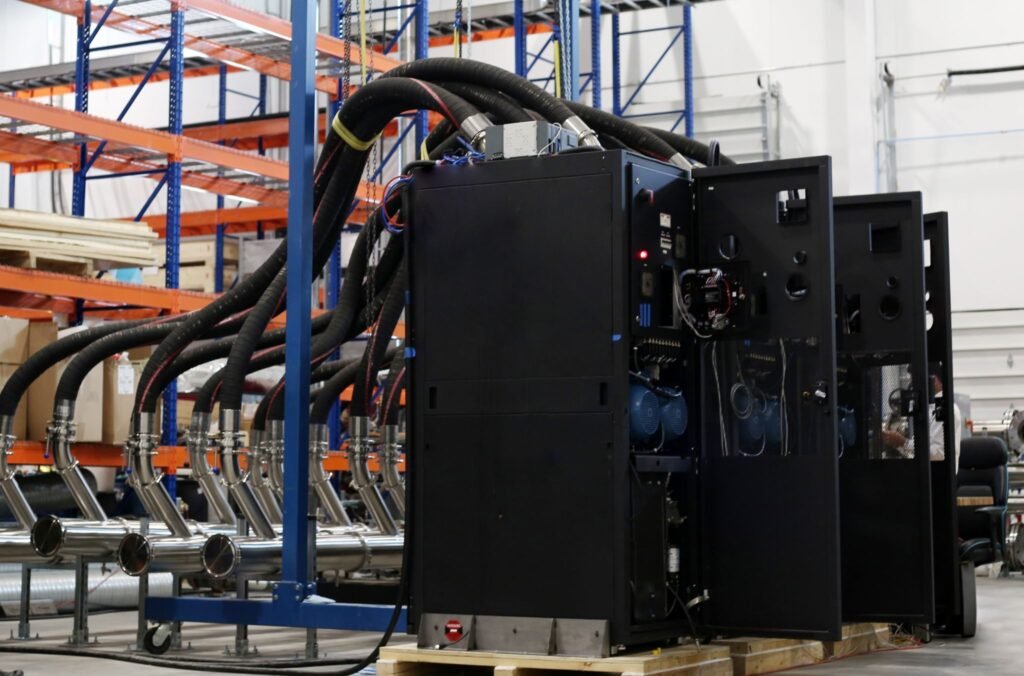
In most projects, the facility already has a source of cooling. That may be chilled water, condenser water, or another central plant loop. But that water is not always suitable to run directly through sensitive IT cooling plates, manifolds, or rear-door systems. The CDU sits between those worlds. It transfers heat from the secondary IT loop to the primary facility loop, and it does that while controlling temperature, pressure, and flow.
From a design point of view, that role includes several jobs:
| CDU function | Why it matters |
|---|---|
| Heat transfer | Removes heat from the IT liquid loop |
| Hydraulic control | Maintains the right flow and pressure |
| Fluid isolation | Keeps facility water separate from IT coolant |
| Monitoring | Tracks alarms, temperatures, pressure, and leaks |
| Protection | Reduces contamination risk and operating instability |
I do not treat the CDU as a passive accessory. I treat it as the part that turns liquid cooling from a concept into an operable system. Without it, many installations become harder to balance, harder to maintain, and harder to expand.
Why CDUs matter for AI, GPU, and high-density racks
AI and GPU racks changed the conversation. Traditional enterprise workloads often gave operators more room for thermal inefficiency, but modern accelerator clusters do not.
Power density rises fast, and the heat is concentrated in small spaces. That makes airflow management much harder.
Liquid cooling helps because liquid carries heat much better than air. But that benefit only becomes reliable when the flow is controlled properly. That is where the CDU becomes essential.
For AI deployments, I pay attention to three business risks:
- Unstable temperatures can reduce compute performance
- Poor liquid loop design can create operational failures
- Future expansion becomes messy if the first CDU is undersized
So I always tell buyers to think past the pilot stage.
How a CDU Works in a Data Center Liquid Cooling Loop
Many teams know they need liquid cooling, but they do not understand the loop. That confusion leads to poor sizing, unstable performance, and expensive retrofit mistakes.
A CDU works by receiving cooling capacity from the facility side and delivering controlled coolant conditions to the IT side.
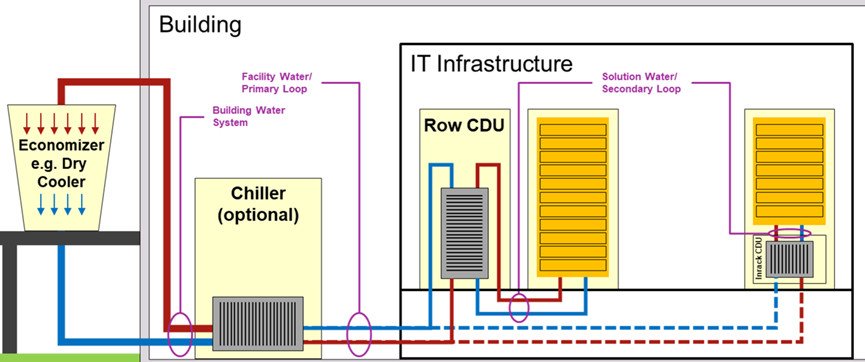
Primary loop vs secondary loop
I usually describe the cooling system as two connected but separate circuits.
The primary loop is the facility side.
The secondary loop is the IT equipment side.
The CDU connects them through a heat exchanger, but the fluids do not mix.
This separation protects sensitive IT cooling systems from facility water conditions. It also allows the IT side to run with tighter control over pressure, temperature, and flow.
Heat exchange, pumping, filtration, and control
A CDU normally contains several critical components:
- Plate heat exchanger
- Circulation pumps
- Filters
- Sensors
- Control valves
- Monitoring systems
Each component contributes to stable operation.
| CDU component | Function |
|---|---|
| Heat exchanger | Transfers heat to facility water |
| Pump | Circulates coolant through racks |
| Filter | Removes particles |
| Sensors | Measure temperature, pressure, and flow |
| Controller | Maintains system stability |
Together they allow operators to maintain a predictable cooling environment.
How CDUs prevent contamination and condensation
Water quality and condensation risk are two hidden issues in liquid cooling.
A CDU isolates the IT loop from facility water and allows filtration and controlled chemistry. This reduces contamination risk in micro-channel cold plates.
Condensation risk is managed by controlling supply temperature. Coolant must stay above the room dew point to prevent moisture forming on components.
Good CDU control systems monitor temperature and adjust flow or heat exchange to maintain safe conditions.
Types of CDUs
Many buyers assume all CDUs are identical, but design differences matter for infrastructure planning.
Liquid-to-liquid CDUs
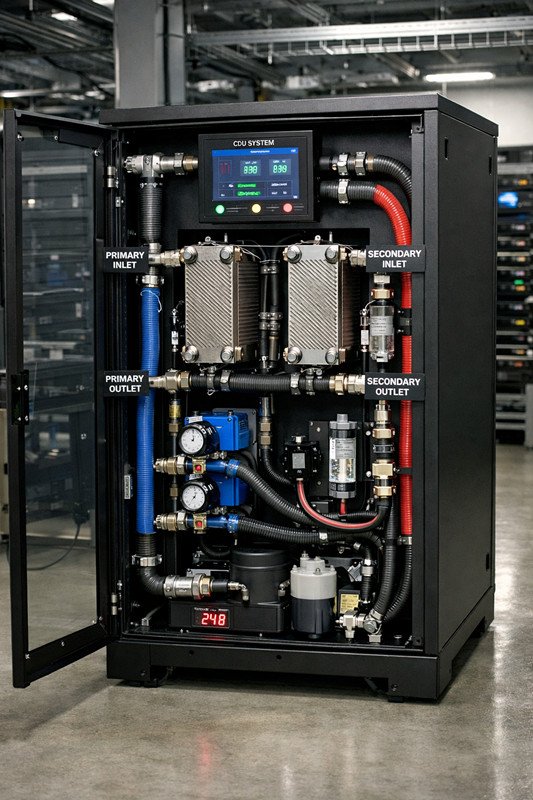
This is the most common design in high-density data centers.
Heat from the IT coolant loop transfers to facility water through a heat exchanger. The two fluids remain separate.
Advantages include:
- Strong heat removal capacity
- Good water quality isolation
- Better compatibility with direct-to-chip cooling
Liquid-to-air CDUs
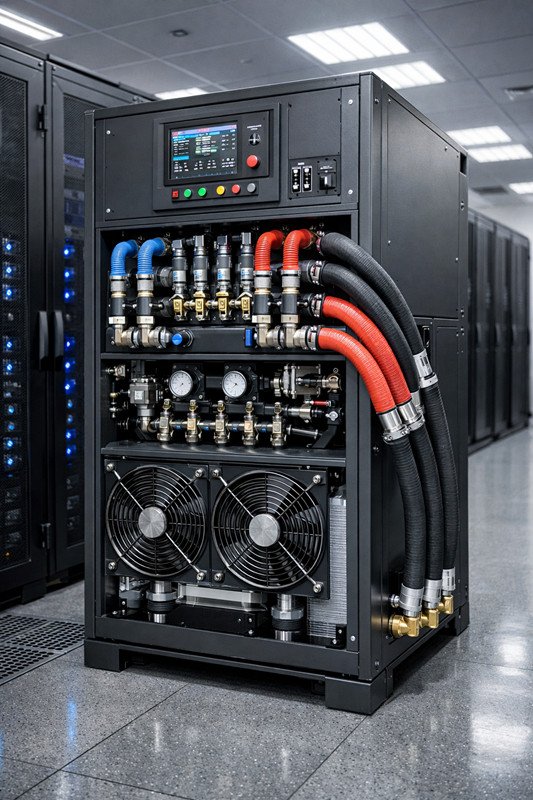
Liquid-to-air CDUs reject heat through air-cooled heat exchangers instead of facility water.
They are useful when building water is unavailable or difficult to access.
However, they generally support lower densities compared with liquid-to-liquid designs.
In-rack vs in-row CDU deployments
CDUs can be installed in different locations.
| Deployment | Advantage | Limitation |
|---|---|---|
| In-rack CDU | Modular expansion | Uses rack space |
| In-row CDU | Shared cooling capacity | Requires floor planning |
The correct choice depends on floor layout and scaling plans.
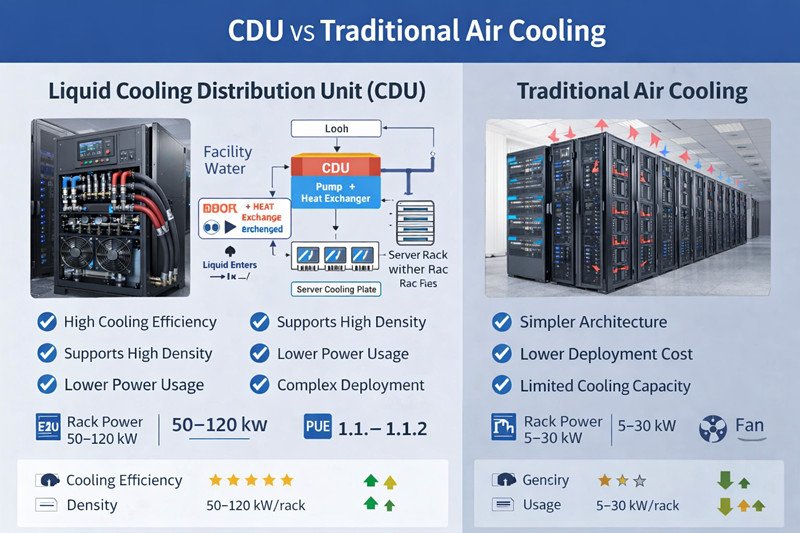
CDU vs Traditional Air Cooling
Air cooling still works for many workloads, but density growth exposes its limits.
Why air cooling struggles at higher rack densities
Air has low heat capacity. Removing large amounts of heat requires very high airflow.
This leads to several challenges:
- Higher fan energy
- Hot spots in racks
- Complex airflow management
When rack power exceeds 30–40 kW, air cooling becomes difficult to manage efficiently.
Where hybrid air + liquid cooling makes sense
Many facilities adopt hybrid systems.
Liquid cooling handles the highest density racks, while air cooling continues to serve standard equipment.
This allows gradual infrastructure upgrades without rebuilding the entire data center.
How to Choose the Right CDU for Your Facility
Selecting the wrong CDU can limit performance and future expansion.
Facility water availability and infrastructure constraints
The first step is understanding building infrastructure.
Important factors include:
- Facility water temperature
- Pressure availability
- Pipe routing feasibility
- Cooling plant capacity
Rack density, workload type, and scalability
Different workloads produce different heat patterns.
AI training clusters produce sustained high heat loads, while enterprise workloads fluctuate more.
Future growth must also be considered.
Redundancy, uptime, and serviceability requirements
Many data centers require redundancy.
This can include:
- Dual pumps
- Backup power
- Isolation valves
Maintenance access is also important.
Floor space, installation speed, and retrofit limitations
Retrofit environments often have space constraints. Equipment footprint and service clearance must be considered during planning.
CDU Sizing and Performance Factors
Correct sizing ensures stable performance and efficient operation.
Flow rate, pressure, and heat exchanger capacity
Three key parameters determine performance:
- Flow rate
- Pressure drop
- Heat exchanger capacity
All must be balanced to meet system demand.
Supply temperature and approach temperature
Supply temperature affects cooling performance and condensation risk.
Approach temperature indicates heat exchanger efficiency.
Lower approach temperature usually means stronger thermal transfer.
Monitoring, alarms, and leak detection
Modern CDUs include monitoring for:
| Monitoring Item | Purpose |
|---|---|
| Temperature | Verify thermal performance |
| Flow | Ensure coolant delivery |
| Pressure | Detect blockage |
| Leak detection | Prevent equipment damage |
Monitoring improves operational reliability.
Common CDU Deployment Scenarios
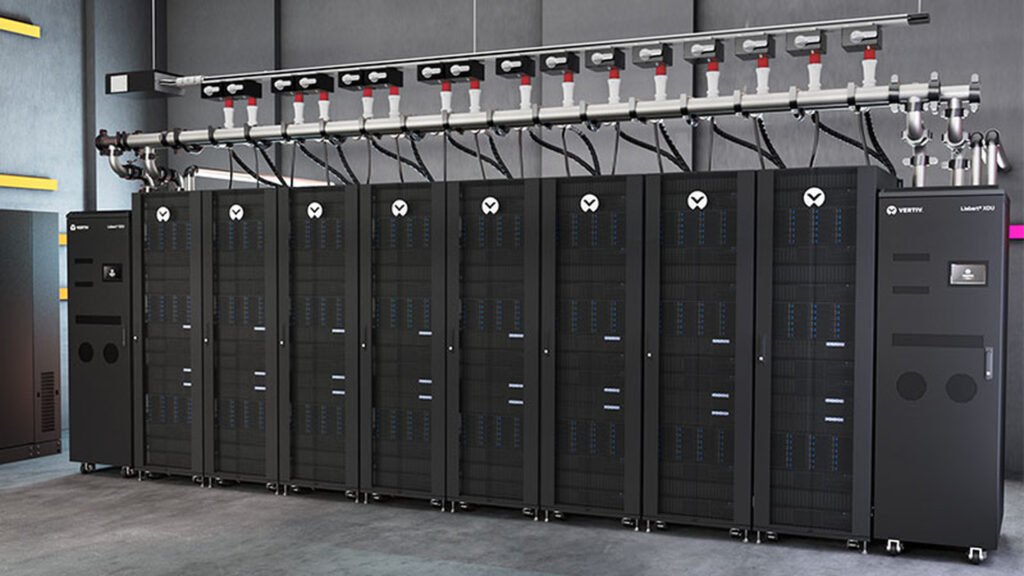
CDUs are used in several typical deployment cases.
Retrofitting a legacy air-cooled data center
Older facilities often retrofit CDUs to support new high-density racks without rebuilding cooling infrastructure.
Supporting direct-to-chip cooling for AI clusters
Direct-to-chip cooling requires stable coolant delivery and is one of the fastest growing CDU applications.
Scaling from pilot deployment to production rollout
Many organizations start with a small pilot system and expand once performance and reliability are proven.
Benefits of a CDU
CDUs provide several advantages in high-density computing environments.
Thermal stability and reliability
Stable coolant temperature improves hardware reliability and reduces thermal throttling.
Energy efficiency and operating cost advantages
Liquid cooling reduces fan energy and improves heat removal efficiency.
Better control for high-density compute environments
Operators gain precise control over flow, temperature, and monitoring.
Common Mistakes to Avoid
Several planning mistakes can cause operational problems later.
Undersizing the CDU
Systems sized only for current load may quickly become insufficient.
Ignoring water quality and maintenance planning
Poor water quality leads to fouling and reduced heat transfer efficiency.
Overlooking redundancy and monitoring needs
Insufficient monitoring can delay response to cooling failures.
CDU Selection Checklist
A structured evaluation helps ensure the right purchase decision.
Questions to ask vendors
| Question | Reason |
|---|---|
| Maximum supported heat load | Confirm capacity |
| Flow and pressure range | Ensure compatibility |
| Redundancy options | Support uptime goals |
| Monitoring capability | Improve operational visibility |
Data points to collect before design and procurement
Before procurement, collect:
- Rack density projections
- Facility water conditions
- Space constraints
- Redundancy requirements
- Monitoring integration needs
Final Thoughts
High-density computing is changing cooling infrastructure requirements.
When a CDU becomes essential, not optional
When rack densities exceed what air cooling can reliably support, a CDU becomes critical infrastructure. It enables stable, scalable liquid cooling for modern AI and high-performance computing environments.
Key Insights
- CDUs enable safe separation between facility cooling water and IT liquid loops
- Liquid cooling becomes necessary as rack density continues increasing
- Proper CDU sizing requires considering flow, pressure, and heat exchanger capacity
- Monitoring, redundancy, and water quality control are critical for reliable operation
- Early infrastructure planning prevents costly retrofits later
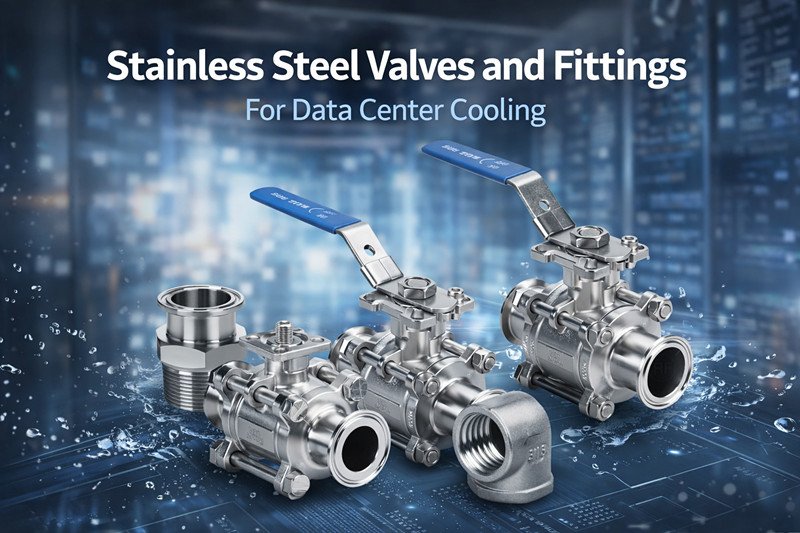
Beyond Fluid is a leading supplier of stainless steel valves and fittings for data center liquid cooling system. If you are a CDU manufacturer, valves & fittings distributor, and Liquid cooling system integrator, please feel free to contact us.